Crypto Money and Thai Bank Accounts in 2026: Is It Legal, Why Banks and Police Block It and What to Do
Crypto & P2P Mike Boldyrev6 min read
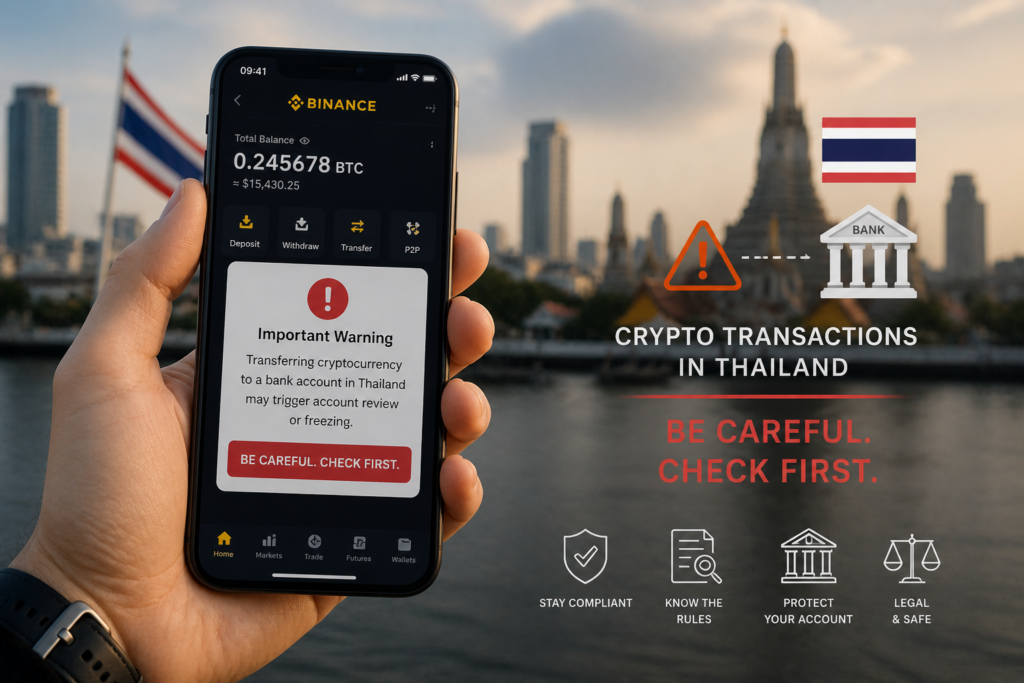
Receiving money from crypto into a Thai bank account is not illegal in itself. Problems start when the bank or the police cannot see where the money came from: a transfer from a stranger after a P2P trade, many small payments, or money that later turns out to come from a scam victim. Then the account is frozen, even if you did nothing wrong.
Below: what is legal, why banks and the police block crypto-related transfers, how to receive money more safely and what to do if the police already ask about your transfers.
In short
- Crypto is legal in Thailand, but regulated. Licensed exchanges are the safest way to move money to your bank.
- Banks block what they cannot explain, not only what is illegal.
- P2P trades are the most common trigger. If the buyer paid you with stolen money, your account can be frozen in a police case.
- Records are your protection. Exchange history, chats and statements decide how fast you get your money back.
Is it legal?
Yes, crypto is legal in Thailand. Digital asset businesses are regulated by the Securities and Exchange Commission (SEC), and licensed Thai exchanges can pay out baht to a bank account in your own name. Some unlicensed foreign platforms have been blocked for Thai users.
The law is only half of the picture. Your bank has its own anti-money laundering rules, and since 2023 Thai rules against technology crime let banks and the police hold suspicious transfers and accounts quickly. That is why a legal trade can still end with a frozen account.
Why banks block crypto-related transfers
A bank does not ask whether your trade was legal. It asks whether it can understand and verify the money. These patterns usually look risky:
- Unknown senders. Money comes from people whose names do not match your exchange account.
- Many small transfers in a short time, especially from different people.
- Fast in and out. Money arrives and leaves the account within minutes or hours.
- A profile that does not match. A tourist or DTV visa with turnover that looks like a business.
- A link to a flagged account. The sender’s account is already part of a fraud case.
When the bank sees this, it may limit transfers, ask you to explain the activity or freeze the account. Why Thai banks freeze accounts
Why the police get involved
Most police cases start with a scam victim. The victim sends money to a buyer on a P2P platform, the buyer uses it to buy your USDT, and the money lands in your account. When the victim files a complaint, the police ask the bank to hold every account in the chain, including yours.
- The police hold is placed through the bank, often without any message from the police to you.
- The investigator asks the account holders to explain the transfers.
- The hold is lifted only with a letter from the police unit that placed it.
Being part of a case does not mean you are a suspect. But you have to show, with documents, that you sold crypto in a real trade and did not know where the buyer’s money came from. Account blocked by the cyber police
How to receive crypto money more safely
- Sell through a licensed Thai exchange and withdraw to a bank account in your own name.
- Avoid P2P with strangers. If you use P2P, trade only with verified users and check that the sender’s name matches.
- Keep records of every trade: exchange history, order numbers, wallet addresses, TXIDs and chats.
- Do not mix accounts. Keep one account for trading income and separate it from salary and business money.
- Match your visa and structure to your income. Regular large income on a tourist visa raises questions. Which visas work for a Thai bank account
- React to the first warning. If the bank calls or limits the app, answer quickly and prepare documents.
If the police ask about your crypto transfers
- Do not ignore it. Ask the bank which police unit placed the hold and get the case details.
- Collect everything: bank statements, exchange history, screenshots, chats with the buyer.
- Prepare a written explanation in Thai for each disputed transfer: who, when, how much and why.
- Keep the same story for the bank and the police, and match it to the documents.
- Go prepared, ideally with someone who speaks Thai and knows how these cases work.
In some cases the complainant asks for the money back, and a settlement is part of the solution. Every case is different. How the release letter works
Common mistakes
- Thinking that a legal trade means the bank will not mind
- Selling P2P to buyers whose names do not match the payment
- Splitting payments into small amounts to stay unnoticed
- Deleting chats and order history after the trade
- Using the same account for salary, business and crypto
- Ignoring SMS or calls from the bank
- Explaining the trades only in words, without documents
A typical situation
A foreigner sells USDT on a P2P platform several times a month. For months everything works. Then one buyer pays with money from a scam victim, and the bank freezes the account after a police request. Because the person kept the order history and chats, the trade can be proved, and the case moves towards a release letter instead of months of uncertainty.
Every case is different, and the decision belongs to the police and the bank. Real cases we worked on
How we can help
We find out who placed the hold, collect and organise your exchange records, prepare the explanation in Thai, communicate with the bank and the police and go with you to the statement. Mike, our founder, traded crypto on P2P platforms himself and knows how to explain a real trade to an officer. We are not a law firm: if your case needs a lawyer, we bring in a licensed Thai lawyer. We cannot promise the result, but we tell you honestly what is realistic before you pay.
Bank account unfreeze from 26,900 THB, cases with a police or cyber police hold usually from 74,900 THB, all including 7% VAT. Fees and timelines
Questions we often hear
Is it illegal to sell crypto for baht in Thailand?
No. Crypto is legal and regulated. The safest route is a licensed Thai exchange that pays out to your own bank account.
Why was my account frozen if I did nothing wrong?
Usually because money in your account is linked to someone else’s complaint, often after a P2P trade. The bank must follow the police request, even if you acted in good faith.
Is P2P trading illegal?
P2P trading is not banned, but it carries the highest risk of receiving money from a scam. Trade only with verified users and keep every record.
How long does it take to release the account?
From a few weeks to several months, depending on the number of police cases, the units involved and how quickly the documents are ready.
Is selling through Bitkub safer than P2P?
Usually yes. Bitkub is a Thai exchange licensed by the SEC, and a withdrawal from your own verified account to your own bank account is easy for the bank to understand. Large or frequent amounts may still need an explanation, so keep your trade history.
This article is general information, not legal or tax advice. Rules on digital assets and bank checks change, so check your situation before you act.
Account frozen after a crypto trade?
Tell us which bank, when it happened and what the bank or the police told you. We usually reply the same business day with the next steps and a written quote.
Similar posts
 Police & cyber policePolice Hold on a Thai Bank Account: How the Release Letter Works, Step by Step08.10.2026
 Frozen bank accountsHow Much Does It Cost to Unfreeze a Thai Bank Account? Fees, Timelines and What’s Included08.10.2026
 Frozen bank accountsInterpreter at a Thai Bank: KYC Interviews, Frozen Accounts and Account Opening25.09.2026

Need help with a bank, visa or business issue?
Tell us what happened, which bank or office is involved and what you need. After a first check, we confirm the scope, the fee and the expected timeline in writing before you pay.
Start your case ↗