How to Open a Company in Thailand in 2026: Company Types, Documents, Steps and Common Mistakes
Company setup & BOI Mike Boldyrev7 min read
Registering a company in Thailand takes about a week. Problems usually come later: the bank will not open an account, the visa does not match the business, or payments are put under review. In most cases the reason is a structure that was not planned before registration.
Below: which company type fits which business, what to decide before you register, the documents you usually need, the steps in the right order and the mistakes we see most often.
In short
- Decide the structure before the paperwork. Your business model, ownership, visa and bank account must fit together.
- The company type depends on what you do. Many activities are restricted for companies with majority foreign ownership.
- Thai shareholders must be real. Nominee shareholders are illegal, and we do not arrange them.
- Registration is only the start. Tax, VAT, social security, a bank account, a work permit and accounting come after it.
Why the structure matters more than the registration
Banks, immigration and the tax office look at the same chain: who owns the company, what it really does, where its money comes from and whether your visa matches your activity. If this chain is clear, the company works. If it is not, even legal income looks risky.
Company → activity → income → bank transactions. Every document you prepare should support this chain, not only pass the registration.
Which company type fits your business
There is no best company type, only the one that fits your real activity. These are the options most foreigners consider:
- Thai private limited company (Co., Ltd.). The most common structure. At least two shareholders. If foreigners hold 50% or more, the company is treated as foreign and cannot do restricted activities without a licence.
- Foreign-owned company with a Foreign Business Licence. Allows majority foreign ownership in some restricted activities, such as many services. It needs government approval, higher capital and time.
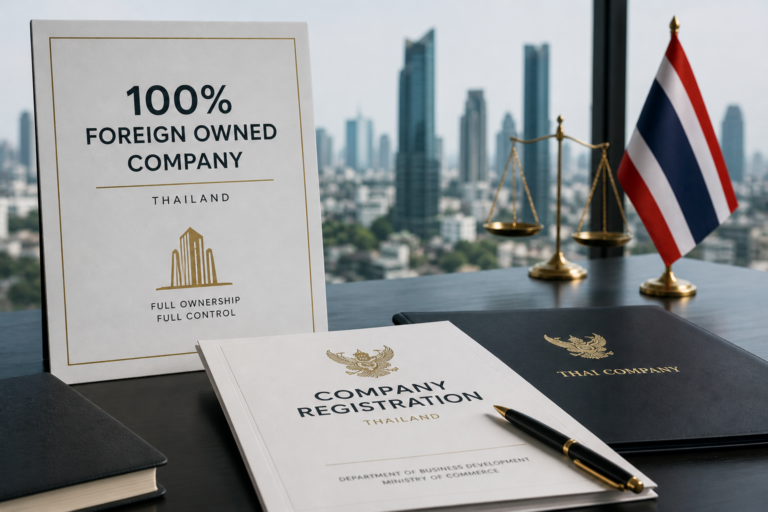
- BOI-promoted company. For qualifying activities such as manufacturing, technology and export. Up to 100% foreign ownership and easier visas and work permits, but the approval process is longer. BOI promotion in detail
Under the Foreign Business Act, a Thai shareholder who only lends their name is a nominee, and nominee arrangements are illegal. If you need majority foreign ownership, the legal routes are a Foreign Business Licence, BOI promotion or an activity that is not restricted.
What kind of business works well for foreigners
- Trading and import-export. Importing goods into Thailand, exporting Thai products and e-commerce. It works well when every payment is backed by contracts and invoices.
- Services and consulting. Marketing, IT, sourcing and agency work. Check early whether your service is restricted for foreign-majority companies.
- Manufacturing and projects for BOI. Factories, suppliers and technology projects often qualify for BOI promotion.
- Online business with Thailand as a base. Possible, but the most common risk is income received into a personal account with no company behind it.
Whatever you choose, the company must reflect what you actually do. A company that exists only on paper is one of the most common reasons for bank account reviews.
Three things to decide before you register
- Your real business model. What the company does, who pays it and how the money will move.
- Ownership and control. Who the shareholders and directors are, and whether your activity is open to foreign ownership.
- Visa, work permit and banking. The company must be able to sponsor your visa and work permit, and its activity must make sense to the bank. Non-B visa and work permit guide
Documents you usually need
Personal documents
- Passport copies of all shareholders and directors
- Visa or entry stamp of foreign directors
- Contact details and address of each person
Company registration documents (DBD)
- Company name reservation, with two or three name options
- Memorandum of Association
- Articles of Association and the minutes of the statutory meeting
- Shareholder list with the number of shares
- Director details and signing authority
- Proof of paid-up capital, where required
Office and address
- Lease agreement or consent letter from the owner
- House registration of the property and the owner’s ID copy
- Map and photos of the office
Business and banking documents
- Clear description of the business and how it earns money
- Expected clients, suppliers and transactions
- Source of funds for the capital and the first payments
Lists change, and each office and bank can ask for more. A shareholder company from abroad, for example a Chinese parent company, also needs its corporate documents legalised for use in Thailand.
Step by step
- Check your situation. Business model, ownership, visa and banking, before any document is signed.
- Reserve the company name with the Department of Business Development (DBD).
- Prepare and sign the registration documents in Thai, with English versions for you.
- Register the company. Registration usually takes about a week once all documents are ready and signed.
- Register for VAT and social security when the business requires it, for example when turnover exceeds the VAT threshold or you hire staff.
- Open the business bank account with a clear explanation of the activity. Bank account opening help
- Arrange visas and work permits for foreign directors and staff.
- Keep it in order. Monthly accounting, tax filings, the annual audit and the shareholder meeting.
Common mistakes
- Registering quickly with a standard template and no plan for banking
- Using nominee shareholders
- Opening a company with no real activity, address or staff
- Receiving business income into a personal account
- Working in your own company on a tourist or DTV visa, without a work permit
- Choosing the cheapest setup without checking ownership restrictions
- Forgetting accounting and filings after the registration
A typical situation
Someone earns from online services or trading and receives the money into a personal Thai bank account. While the amounts are small, nothing happens. As the income grows, the bank asks for contracts, invoices and the source of funds, and there is no company to explain them. The account is put under review or frozen.
The fix is a real structure: a company with the right activity, a business account, a visa and work permit, and payments backed by documents. It works much better when it is built before the problem. If your account is already restricted, start there first. Frozen bank account help
For Chinese companies
If you are a company from China setting up a subsidiary, a factory or a supplier in Thailand, we have a separate guide with modules for registration, BOI and staff from China. Thailand setup for Chinese companies
How we can help
We check your business model and the right company type, prepare the documents in Thai and English, coordinate the registration with our licensed partners and help you open the business bank account. Visas, work permits and accounting can be planned in the same process. We are not a law firm: licensed Thai lawyers and accountants handle the parts that require them. We cannot promise any decision, but we tell you honestly what is realistic before you pay.
Company setup from 31,900 THB, company with a business bank account from 89,900 THB, monthly accounting from 5,290 THB, all including 7% VAT. Government fees are separate. Company setup and prices
Questions we often hear
Can a foreigner own 100% of a Thai company?
Only in some cases: with BOI promotion, a Foreign Business Licence or for activities that are not restricted. In an ordinary Thai company, foreigners usually hold up to 49%.
Can I use a Thai friend as a shareholder on paper?
No. A shareholder who only lends their name is a nominee, and this is illegal. Thai shareholders must be real investors.
How long does registration take?
Usually about a week once all documents are ready and signed. Documents from abroad, legalisation, BOI and the bank account take longer.
Do I need a work permit to work in my own company?
Yes. Owners and directors who work in the company need a Non-B visa and a work permit.
Can I open the company remotely?
Often yes, with a power of attorney and documents signed and legalised abroad. Opening the business bank account usually needs the director in person.
This article is general information, not legal advice. Requirements change, and each office can apply them differently.
Planning a company in Thailand?
Tell us what the company will do and who will own it. We usually reply the same business day with the right structure and a written quote.
Similar posts
 Police & cyber policePolice Hold on a Thai Bank Account: How the Release Letter Works, Step by Step08.10.2026
 Frozen bank accountsHow Much Does It Cost to Unfreeze a Thai Bank Account? Fees, Timelines and What’s Included08.10.2026
 Frozen bank accountsInterpreter at a Thai Bank: KYC Interviews, Frozen Accounts and Account Opening25.09.2026

Need help with a bank, visa or business issue?
Tell us what happened, which bank or office is involved and what you need. After a first check, we confirm the scope, the fee and the expected timeline in writing before you pay.
Start your case ↗